


When selecting front brake pads, it is essential to understand the differences between popular friction material formulations and product tiers. At FBK, we rigorously test each type according to international standards such as JASO, SAE, and ECE R90. This ensures you receive reliable, repeatable performance in every product line.

- Organic Pads:
• Approximate friction coefficient (μ): 0.35–0.42
• Lifespan: 20,000–30,000 km
• Lower dust, quieter operation
• Best for light-duty city driving - Semi-Metallic Pads:
• Approximate friction coefficient (μ): 0.40–0.50
• Lifespan: 30,000–45,000 km
• Higher thermal stability, moderate noise
• Suited for general and commercial vehicles - Low-Metallic Pads:
• Approximate friction coefficient (μ): 0.38–0.48
• Lifespan: 25,000–40,000 km
• Good initial bite, increased dust
• Ideal for moderate performance vehicles - Premium vs. Standard Lines:
• Premium pads: Consistent μ across temperature, tested at 100–600°C
• Standard pads: Sufficient for normal use, tested up to 400°C
• Premium lines offer improved fade resistance and lower noise levels
Red flags
- Using organic pads in heavy-duty or high-temperature applications may cause rapid wear and reduced braking efficiency.
- Choosing under-tested brake pads without ECE R90 or JASO certification can result in unpredictable performance and increased risk of noise or vibration.
- Mixing incompatible pad types (e.g., low-metallic with organic) on the same axle compromises brake balance and safety.
How to Choose the Right FBK Front Brake Pads
FBK offers a comprehensive range of front brake pads tailored to various vehicle types and driving conditions. Our products undergo laboratory friction testing, dynamometer trials, and real-world validation to ensure consistent quality and compliance with international standards.
- Driving Profile:
• City/commuter: Organic or low-metallic formulations
• Commercial/heavy-duty: Semi-metallic or premium lines
• Performance/sport: Premium low-metallic or ceramic options - Performance Requirements:
• Stable friction at 20–600°C for premium pads
• Noise and vibration tests per SAE J2521
• ECE R90 homologation for OE replacement - Vehicle Compatibility:
• Match pad dimensions and backing plate design to OE specifications
• Check for integrated wear sensors or shims
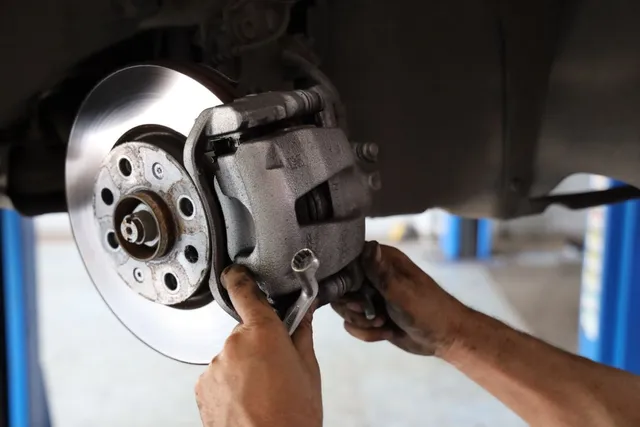
Key points to remember
- Always consult your vehicle’s manual and FBK’s application guide before selecting front brake pads.
- Choose pads that meet or exceed your vehicle’s original specifications and intended use.
Understanding Specifications: Friction, Noise, and Wear
Understanding technical specifications is essential when evaluating brake pad quality. FBK clearly labels the friction level, noise performance, and wear rate for every pad. Each product follows strict testing protocols to ensure reliable and repeatable results.
- Friction Level (μ):
• Typical range: 0.35–0.50
• Higher values indicate stronger braking effect, tested at multiple temperatures - Noise Behaviour:
• Measured in dB(A) during SAE J2521 dynamometer testing
• Premium pads: <37 dB(A) average
• Standard pads: <40 dB(A) average - Wear Rate:
• Measured in mm/1,000 km
• Premium: 0.2–0.3 mm/1,000 km
• Standard: 0.3–0.5 mm/1,000 km - Temperature Stability:
• Premium pads resist fade up to 600°C
• Standard pads maintain integrity up to 400°C
Key points to remember
- Consistent laboratory and dynamometer results are essential for real-world reliability.
- Always review product datasheets for certified friction, wear, and noise values.
Ensuring Quality Installation and Inspection
Proper installation and regular inspection are essential to maximize the performance and lifespan of your FBK front brake pads. Our products are engineered for OE-fit precision. However, correct fitting and thorough post-installation checks are equally important to ensure optimal results.
- Installation Checklist:
• Clean caliper and slide pins thoroughly
• Check disc thickness and surface finish
• Apply correct torque to caliper bolts
• Install any included shims or anti-rattle clips - Post-Installation Inspection:
• Confirm pedal feel and response
• Listen for abnormal noise during bedding-in
• Inspect for even pad contact and wear after 500–1,000 km - Maintenance Intervals:
• Visual checks every 10,000 km
• Replace pads when friction material reaches 3 mm thickness
Key points to remember
- Professional installation ensures full compliance with FBK’s tested performance standards.
- Regular inspections help detect early signs of wear or improper fitting, preventing costly repairs.
Conclusion
Choosing the right FBK front brake pads starts with understanding your vehicle’s requirements and your driving style. Compare the available formulations and review the certified specifications carefully. Make sure the pads are installed properly to ensure optimal performance. With FBK, you can trust safe and reliable braking. Schedule regular inspections and always choose pads tested to international standards for maximum safety and value.